
Commercial Roof Winterization Checklist: 7 Mandatory Steps Before Maine’s First Snowstorm
Maine winters place extraordinary mechanical and thermal stress on commercial flat roofs. Between heavy coastal nor’easters, deep lake-effect snows in Bangor and Lewiston, and brutal sub-zero freeze-thaw cycles, an uninspected commercial roof can quickly turn into a multi-million-dollar structural and business interruption catastrophe.
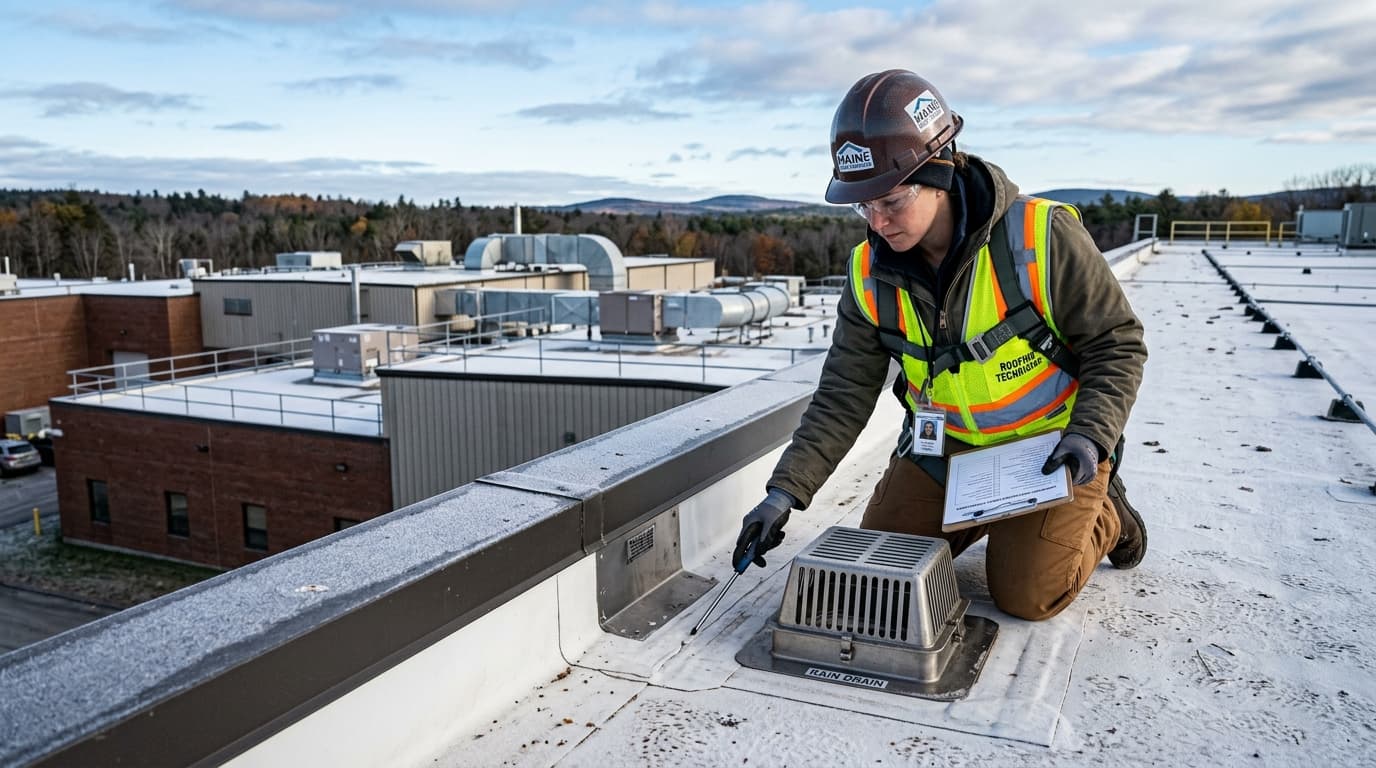
Certified Pre-Winter Commercial Inspection & Drain Clearing on an Industrial Facility in Maine
Direct Answer for Facility Managers & CFOs
Maine Uniform Building and Energy Code (MUBEC) Winter Readiness Standard
Commercial roof winterization in Maine requires completing seven critical tasks before November 15: clearing interior drains and parapet scuppers, ultrasonic or infrared seam inspection of TPO/EPDM membranes, resealing HVAC mechanical curb flashings, testing heat trace cables, clearing ponding depressions, trimming overhanging pines, and establishing a priority snow-removal contract before nor’easters dump 30+ lbs/sq.ft of dense snow.
Why Maine Winters Are Brutal on Commercial Flat Roofs
Unlike residential sloped roofs that allow gravity to shed snowpack naturally, commercial flat roofs (single-ply TPO, EPDM rubber, PVC, or built-up modified bitumen) are engineered to retain moisture until drainage systems can discharge it.
In Maine, winter brings sudden, violent fluctuations. A 45°F rainy Atlantic front can transition to 5°F sub-zero winds within six hours. When trapped water freezes, it expands by 9% in volume. This hydraulic force will split unsealed membrane laps, fracture brittle drain bowls, and pry flashings away from masonry parapet walls.
| Snow / Ice Condition | Weight per Cubic Foot | Weight on 10,000 sq ft Roof (12 inches) | Maine Structural Risk Level |
|---|---|---|---|
| Fresh Light Powder | 3 to 5 lbs / cu.ft | 30,000 to 50,000 lbs | Low Structural Stress |
| Settled Mid-Winter Snow | 12 to 18 lbs / cu.ft | 120,000 to 180,000 lbs | Moderate — Monitor Drains |
| Wind-Packed / Saturated Rain-on-Snow | 20 to 32 lbs / cu.ft | 200,000 to 320,000 lbs | Elevated Deflection Warning |
| Solid Ice / Frozen Ponding Water | 57.2 lbs / cu.ft | 572,000 lbs (286 Tons) | CRITICAL COLLAPSE DANGER |
The 7 Mandatory Commercial Winterization Steps
Clean, Clear & Secure All Roof Drains, Scuppers & Strainers
Debris accumulation from fall foliage is the primary killer of commercial roofs. Remove leaves, pine needles, and sediment from all primary cast-iron drain domes, secondary overflow scuppers, and interior leader lines. Ensure clamping rings are tightened to manufacturer torque specifications. If a drain is clogged when freezing temperatures hit, standing water will freeze solid and back up across hundreds of square feet.
Probe Every Membrane Seam (TPO, EPDM, PVC)
A roofing technician must mechanically probe every single heat-welded or taped lap seam across the roof plane. Thermal contraction in January pulls seams tight; if a seam has an unbonded 1/4-inch fishmouth or hairline void, blowing snow will infiltrate beneath the membrane, soak polyiso insulation, and cause extensive dry rot and R-value loss before spring.
Inspect & Reseal Parapet Walls, Coping Caps & Reglets
Nor’easters deliver horizontal driving winds in excess of 60 mph along the Maine coast. Inspect metal coping caps, termination bars, and counter-flashings along all perimeter parapet walls. Old, dried polyurethane caulking must be scraped out and replaced with commercial-grade elastomeric silicone sealant that remains flexible down to -30°F.
Audit Rooftop HVAC Curbs, Pipe Penetrations & Pitch Pockets
Over 70% of active winter leaks occur at mechanical rooftop equipment rather than the open field membrane. Inspect rooftop air handlers, chiller curbs, exhaust fan hoods, gas pipes, and conduit penetrations. Replace degraded EPDM pipe boots and refill dried, cracked pitch pans with pourable polyurethane or silicone sealant before snow covers them.
Map Low Spots & Correct Ponding Water Depressions
The National Roofing Contractors Association (NRCA) defines ponding water as liquid that remains 48 hours after precipitation. In Maine’s late autumn, standing water freezes into massive ice sheets that grind against the membrane surface during freeze-thaw cycles. Identify low spots and install tapered insulation sumps or additional roof drains before the freeze.
Test Self-Regulating Heat Trace Cables in Drains & Gutters
If your commercial facility utilizes electric de-icing heat trace cables inside exterior gutters, downspouts, or internal drain risers, test breaker circuits and thermostatic controllers now. A dead heating cable discovered after the first 18-inch snowstorm will result in frozen, ruptured drainage pipes inside your facility's ceiling plenum.
Establish a Priority Snow Removal & Emergency Response Contract
When a catastrophic blizzard dumps 30 inches of wet snow on Southern and Central Maine, every commercial roofing crew in the state is booked solid. Trying to hire an emergency crew during the storm leads to price gouging or untrained snow shovelers using sharp metal spades that puncture your rubber membrane. Pre-contracting an emergency snow-removal agreement guarantees 24-hour response with certified crews using low-pressure steam and safe non-destructive equipment.
The Cost of Proaction vs. Winter Reaction
According to commercial insurance loss statistics in New England, proactive pre-winter maintenance yields a 12:1 return on investment by preventing catastrophic water damage, inventory ruin, and structural deflection claims.
$850 – $2,500
- • Certified commercial roof audit & drain cleaning
- • Seam probe check & elastomeric silicone resealing
- • Written report for commercial property insurance files
- • Priority 24/7 winter storm dispatch status
$45,000 – $250,000+
- • Structural roof deck deflection or partial collapse
- • Ruptured internal drain pipes flooding inventory
- • Denied insurance claims due to "lack of routine maintenance"
- • Multi-week business operations interruption
Schedule Your Commercial Roof Winterization Inspection Before Maine’s First Freeze
Our certified commercial roofing technicians inspect industrial facilities, multi-unit complexes, retail plazas, and warehouses across Maine and New Hampshire. Get a comprehensive drain, seam, and flashing audit with documented photo proof for your insurer.
Frequently Asked Questions: Maine Commercial Roof Winterization
When should a commercial roof in Maine be winterized?
Commercial roof winterization in Maine should occur between September 15 and November 15, well before sustained sub-freezing temperatures arrive and before the first major nor'easter snow event.
What is the number one cause of commercial flat roof failure during Maine winters?
Blocked internal roof drains and scuppers. When leaves and debris clog drains, autumn rainwater freezes into a solid ice dam. Subsequent snowmelt cannot drain and pools on the membrane, creating concentrated loads exceeding 50 lbs per square foot that threaten structural collapse.
How much does professional commercial roof winterization cost in Maine?
A comprehensive commercial roof winterization inspection in Maine typically ranges from $850 to $2,400 depending on square footage, mechanical equipment density, and whether infrared thermal moisture scanning is performed.